Built for Smart India Hackathon 2025 to solve real farming problems with practical AI and offline-first delivery.
Project Snapshot
Hackathon: Smart India Hackathon 2025
Problem Statement ID: 25010
Title: Smart Crop Advisory System for Small and Marginal Farmers
Theme: Agriculture, FoodTech and Rural Development
Category: Software
Team: Quantum Crew
Demo Video: https://www.canva.com/design/DAGy0NCssmw/Si7NwvVs-ENCFGAGJU0lsQ/watch
What We Built
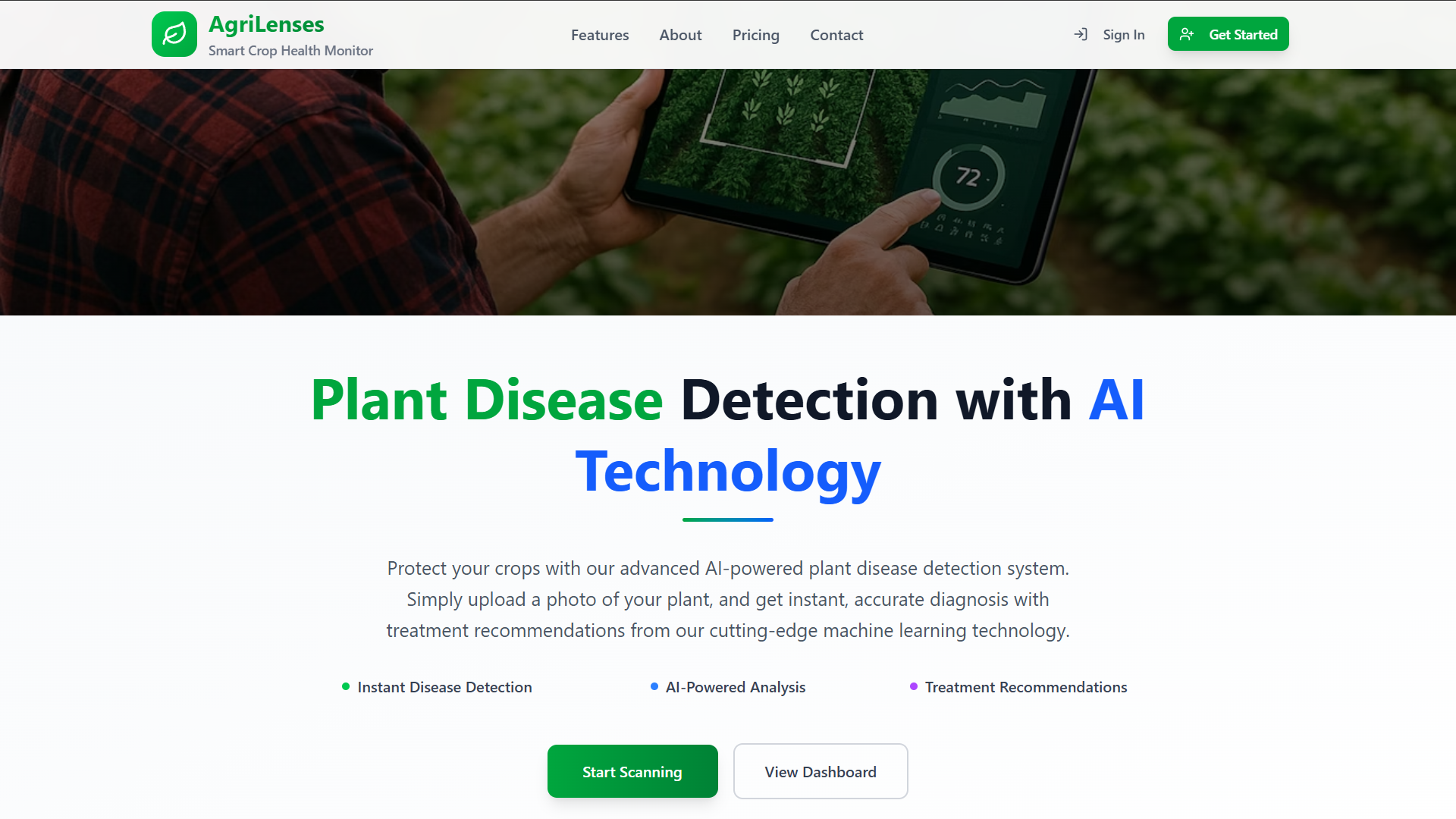
AgriLenses is a smart advisory platform that helps farmers decide what to grow, when to irrigate, how to respond to pests, and where to sell for better prices.
The system combines:
- Soil Health Card (SHC) data
- Weather signals
- Mandi prices and eNAM trends
- Voice and multilingual chatbot interaction
- Offline IVR/SMS fallback for low-connectivity regions
Why This Matters
Most small and marginal farmers face three practical issues:
- Recommendations are not hyperlocal
- Digital products assume literacy and internet availability
- Advice is fragmented across multiple portals
AgriLenses addresses this by providing one integrated, local-language advisory flow that is usable even without stable internet.
Technical Architecture
Farmers can provide inputs through:
- Village/location details
- Soil and crop information
- Pest images
- Voice queries in local language
Intelligence Layer
The AI engine combines multiple signals to generate actionable advice:
- CNN models for pest and disease image detection
- NLP pipeline for multilingual intent understanding and advisory generation
- ML forecasting models for mandi price prediction
- Rule-based recommendation logic for irrigation and fertilizer scheduling
Delivery Layer
Advice is delivered in formats that are practical for field use:
- Mobile app/chatbot response
- Local-language text and audio output
- Offline IVR and SMS fallback for no-data zones
Integrations and Ecosystem Alignment
- SHC for soil health context
- PMFBY references for risk and insurance awareness
- eNAM/mandi price feeds for better selling decisions
- Designed for future AgriStack alignment to support scale across states
My SDE Contribution
I focused on building a practical software architecture that can move from hackathon prototype to deployable product:
- Designed end-to-end advisory flow (input -> AI processing -> multilingual output)
- Defined service boundaries for model inference, data aggregation, and advisory APIs
- Built backend-ready structure for integrating weather, soil, and market data sources
- Planned offline-first delivery strategy using IVR/SMS for low-connectivity areas
- Documented model selection strategy for CV (CNN), NLP, and price forecasting
Feasibility and Scale
The solution is feasible because it uses a modular architecture:
- Cloud-based core services for model inference and data orchestration
- Lightweight client channels (chatbot/mobile)
- Offline channels (IVR/SMS) for rural accessibility
- Multilingual dataset strategy for cross-state deployment
This allows phased rollout from district pilots to broader state-level deployment.
Expected Impact
Based on cited pilot studies and reports:
- Yield improvement: 10-25%
- Fertilizer/pesticide input reduction: 15-20%
- Crop loss reduction via early alerts: ~20%
- Income uplift via market timing and discovery: 8-15%
Beyond metrics, the biggest impact is accessibility: farmers receive advice in their own language and through channels they already use.
References Used
- NABARD Report 2022 (small and marginal farmer distribution)
- FAO studies on ICT-enabled advisory outcomes
- Springer paper on AI-based pest and disease detection
- World Bank case studies on ICT for agriculture productivity
Summary
AgriLenses demonstrates my ability to design real-world, impact-focused AI products with clear system boundaries, offline-first constraints, and multilingual user experience. It reflects practical SDE strengths in architecture, data integration, model-driven workflows, and product feasibility for national scale.